Showing posts with label Sweet. Show all posts

Monday, 13 January 2025

Thiruvadhirai Kali (திருவாதிரை களி)

During the winter month of Margazhi (மார்கழி), on the day of thiruvadhirai star (திருவாதிரை நட்சத்திரம்), the celestial dance of Lord Nataraja (நடராஜப் பெருமான்) is celebrated in Shiva temples across Tamil Nadu. On this day devotees fast and a special preparation called "kali" (களி) is offered to the lord. Today, let me share with you the traditional recipe of "Thiruvadhirai Kali" (திருவாதிரை களி).

Ingredients:

Raw rice - 1 cup or 200 ml measure

Green gram dhal or moong dhal - 1 tablespoon

Bengal gram dhal or channa dhal - 1 tablespoon*

Jaggery - 2 cups or 400 ml measure

Cardamom - 5-6 no, powdered

Coconut - grated, 2 tablespoons

Ghee - 3 tablespoons

Cashew nuts - 12 no, broken

* In some parts of Tamil Nadu, channa dhal is used. You may omit it, if desired.


Method:

  • Roast raw rice and dhal/s in a kadai on medium flame till the items start to turn light brown in color. Transfer to a bowl immediately. Once the roasted items cooled down to room temperature, grind in a mixed-grinder to rava consistency. Keep aside.
  • Mix jaggery and 5 cups of water in a kadai. Bring it to boil. Add in 1 tablespoon of ghee and coconut gratings. Mix well. Reduce the flame. Now add the ground rice-dhal mixture slowly while stirring continuously to avoid lumps. Add in cardamom powder and 1 tablespoon of ghee. Continue to cook till the mixture thickens.
  • Transfer the mixture to a vessel, cover it with a lid and pressure cook for 4 minutes or 4 whistles.
  • Once the pressure subsides, remove from the cooker and allow it to cool.
  • Heat the remaining ghee in a tadka pan, add in cashew nuts and fry till they turn golden brown in color.
  • Add the tadka to kali and mix well. Thiruvadhirai kali is ready!

If you like this post, please share it with your friends, followers or contacts, by just clicking the 'Face book', 'Twitter', ‘Pinterest’ icons you see below the post. Feel free to post your comment/ feedback. Your support is greatly appreciated. Thank you!

Wednesday, 30 October 2024

Badusha (பாதுஷா)

Traditionally, Diwali celebrations call for preparing an array of sweets for the family to enjoy! Badusha (பாதுஷா) is one of the popular sweets made for Diwali festival. Let's see how to prepare this yummy sweet at home!

Ingredients: (makes 15 pieces)

All purpose flour or maida - 1 cup or 240 ml measure

Fresh curds - 2 tablespoons

Baking soda - ⅛ teaspoon 

Baking powder - ¼ teaspoon 

Ghee - 2 tablespoons

Cardamom - 3 no, powdered

Sugar - 1 cup or 240 ml

Saffron - a few strands

Pistachio or almond - 4 no, sliced

Lemon juice - 1 tablespoon

Oil - for deep frying

Milk - as needed


Method:

Preparing the dough 
  • Mix curds with baking soda and baking powder in a bowl. Whisk very well till the curds become frothy.
  • Add in all purpose flour and ghee. Gently knead to form a soft dough. If required, add 1-2 teaspoons of milk while kneading to get the right consistency (Fig.1). Cover with a damp muslin cloth and allow the dough to rest for 30 minutes.
  • Later, divide the dough into 15 portions. Shape each portion into a ball, flatten it into a 2" disc and make a depression in the center (Fig.2). Repeat the process with the remaining dough.
Preparing the sugar syrup
  • Mix sugar and ¼ cup or 60 ml of water in a kadai. Heat the kadai on medium flame till the sugar dissolves fully. Bring it to boil and then simmer.
  •    String consistency
    Stir continuously and you will find that the syrup starts to thicken. At this stage, the syrup is sticky to touch. Soon the syrup reaches 'half-string consistency' and then ‘string consistency' (Fig👉) – when touched between thumb and index fingers the syrup stretches like a string. 
  • For badusha, you need 'half-string consistency' (before it reaches string consistency) – when touched between thumb and index fingers the syrup DOES NOT FULLY stretch like a string but breaks mid way. At this stage, add in lemon juice and mix well.
  • Switch off the stove. Add in saffron strands, powdered cardamom and mix well. Cover the sugar syrup and keep aside.
How to check the consistency of sugar syrup: Place a drop of the syrup on a plate and let it cool for a few seconds. Touch the syrup with your index finger and press it with your thumb. Then separate the fingers. If the syrup stretches between the fingers, but breaks midway, it has reached the ‘half-string consistency’ (அரை கம்பிப் பாகு). If it stretches as a thick string between the fingers, it has reached the ‘string consistency’ (கம்பிப் பாகு).  

Preparing the badushas
  • Heat oil in a kadai on low flame. Once it is hot, drop a small bit of dough in the oil. If it rises to the surface, oil is ready.
  • Drop the prepared dough discs gently in the oil, one by one, 4-5 at a time. Once cooked, they rise to the surface (Fig.3).
  • Turn them over and cook till they turn golden brown on all sides (Fig.4).
  • Remove the cooked badushas from oil and place them on a tissue paper. Drop the next set of dough discs in oil.
  • Now transfer the cooked badushas to the kadai containing sugar syrup and dip them fully in the syrup. Let them soak for 10 minutes. Turn them over and soak for another 5 minutes in the syrup. Then transfer them to a plate.
  • Repeat the process with the remaining dough. Once all the badushas are soaked in sugar syrup and transferred to the plate, garnish them with sliced nuts (Fig.5).
  • Allow the badushas to cool fully and store in an air-tight container.
Note: After making badusha, you may have left over sugar syrup, which you can use to make payasam or kheer. 

If you like this post, please share it with your friends, followers or contacts, by just clicking the 'Face book', 'Twitter', ‘Pinterest’ icons you see below the post. Feel free to post your comment/ feedback. Your support is greatly appreciated. Thank you!

Tuesday, 29 October 2024

Okkarai (ஒக்காரை)

Okkarai (ஒக்காரை) is the traditional sweet that is made in the Brahmin homes on Diwali day, especially in the southern part of Tamil Nadu. This sweet is made using dhal, jaggery and very limited quantity of ghee, which makes it a healthy Diwali sweet option! Let us make okkarai for this Diwali!

Ingredients:

Bengal gram dhal (channa dhal) - 1 cup or 200 ml measure*

Jaggery - powdered, 1 cup or 200 ml measure

Ghee - 2 tablespoon

Cashew nuts - 12 no, broken

Cardamom - 3 no, powdered

Salt - a pinch

Coconut - grated, 1 tablespoon (optional)

* Dhals in various combinations are used to make okkarai, such as Bengal gram dhal only, (green gram dhal) moong dhal only, Bengal gram dhal and moong dhal (1:1 ratio or 2:1 ratio) or Bengal gram dhal, moong dhal and (Red gram dhal) thur dhal in 1:2:1 ratio). I prefer to use Bengal gram dhal alone.


Method:
  • Roast Bengal gram in a kadai till it starts to turn reddish in color. Transfer to a bowl and soak in sufficient water for 2 hours.
  • Roast the grated coconut in the kadai till the it turns light brown in color. Keep aside.
  • Later drain water and grind the dhal with salt in a mixer-grinder into a slightly coarse paste.
  • Heat ghee in the kadai, add in cashew nuts and fry till they turn light brown in color. Transfer the nuts to a bowl. 
  • Add in the ground dhal paste to the kadai and mix with the remaining ghee. Cover and cook on low flame, stirring occasionally till the paste is cooked and starts to crumble as shown in the picture. 
  • Meanwhile, add jaggery powder to another kadai or a thick bottomed vessel. Add in ¼ cup (50 ml) of water and mix well. Bring it to boil and continue to cook on medium flame. First the syrup boils and starts to thicken. At this stage, the syrup is sticky to touch. Soon the syrup reaches ‘string’ consistency – when touched between thumb and index fingers the syrup stretches like a string. Now reduce the flame and continue to stir till the syrup reaches ‘soft ball consistency’ (உருட்டுப் பாகு).
  • Now add the cooked dhal mixture to the syrup. Mix well and continue to cook on low flame till the syrup is fully absorbed. Add in cardamom powder, fried cashew nuts and roasted coconut gratings. Mix well and remove from fire. Okkarai is ready!
Soft ball consistency

How to check the consistency of jaggery syrup: Drop little syrup in water. If it dissolves, the syrup is not ready. If it stays intact and you are able to roll the syrup into a soft ball, the syrup has reached 'soft ball consistency'.

Note: If you add coconut, you will have to use up the sweet within a day. Without coconut, okkarai stays good for 3-4 days.

If you like this post, please share it with your friends, followers or contacts, by just clicking the 'Face book', 'Twitter', ‘Pinterest’ icons you see below the post. Feel free to post your comment/ feedback. Your support is greatly appreciated. Thank you!

Tuesday, 27 August 2024

Badam Kheer (பாதாம் பருப்பு பாயசம்)

The festival season has started and it is time to try different sweet recipes to enhance the festivities! Here's the popular kheer or payasam recipe that has a subtle taste.

Ingredients:

Milk - 750 ml, preferably full cream milk*

Sugar - half a cup or 100 ml measure (adjust to taste)

Almonds - half a cup or 100 ml measure

Almond slices - 2 tablespoons

Saffron - a few strands

Cardamom - 2 no, powdered

* You can, however, use any type of milk such as toned milk, standardized milk etc.


Method:

  • Soak almonds in hot water for 15-20 minutes. Later simply squeeze the almond to separate the skin. 
  • Grind the almond nuts with required water in a mixer-grinder to form a smooth paste. Keep aside.
  • Roast almond slices in a kadai on low flame till they start to turn light brown in color. Transfer to a bowl. 
  • Bring the milk to boil in a thick bottomed vessel on low flame. Dilute almond paste in little water and add to the boiling milk slowly, while stirring continuously. Simmer for 2 minutes.
  • Add in saffron strands, cardomom powder and sugar. Mix well. Simmer for 5 minutes.
  • Switch off the stove. Cool to room temperature. You may refrigerate the kheer and serve chilled.
  • Garnish with roasted almond slices before serving.

If you like this post, please share it with your friends, followers or contacts, by just clicking the 'Face book', 'Twitter' or ‘Pinterest’ icons you see below the post. Feel free to post your comment/ feedback. Your support is greatly appreciated. Thank you! 

Tuesday, 19 March 2024

Kâradai (காரடை)

Traditionally, kâradai (காரடை) is prepared for the festival called "Kâradaiyan nombu" (காரடையான் நோன்பு) or "Savithri nombu" (சாவித்ரி நோன்பு), celebrated on the first day of Tamil month "Panguni" (பங்குனி). This festival is mainly celebrated in South India. On this day, married women observe fasting since morning till the pooja is concluded, and pray for the longevity and well-being of their husbands. Kâradai is made as a pooja offering. Both sweet and salt varieties of kâradai can be made, and it can be served as a snack as well. Let us proceed with this traditional recipe.

Ingredients: (Makes 12 pieces each)

Sweet kâradai:
Idiâppam flour - 1 cup or 200 ml measure*
Jaggery powder - 1 cup or 200 ml measure
Cardamom - 2 no, powdered
Coconut - grated, 2 tablespoons
Karamani or black eyed pea - 2 tablespoons**

Salt kâradai:
Idiâppam flour - 1 cup or 200 ml measure*
Coconut - grated, 2 tablespoons
Karamani or Bengal gram dhal - 2 tablespoons**
Green chili - 1 no, chopped
Ginger - ½" piece, grated
Oil - 1 tablespoon
Mustard - 1 teaspoon
Split urad dhal - 1 teaspoon
Asafoetida - a generous pinch
Curry leaves - a few
Salt - to taste

*Traditionally raw rice is washed several times in water and left to dry in the shade. When half dry, it is powdered finely, sifted through a sieve and lightly roasted. As this process is laborious, I use store bought idiâppam flour and it works well for me.
** You can use either red or white karamani.


Method: 

How to make sweet kâradai:
  • Wash and soak karamani or black eyed pea in sufficient water for one hour. Later cook in a pressure cooker for 5 minutes. Keep aside. 
  • Dissolve jaggery powder in 1¼ cups (250 ml) of water and bring it to boil in a kadai. Reduce the flame. Add idiâppam flour slowly to the jaggery water, while stirring continuously without forming lumps. When the flour mixture forms a mass, switch off the stove. Add in cooked karamani, grated coconut and cardamom powder. Mix well.
  • Smear idly mould with oil and keep ready.
  • Divide the mixture into 12 equal sized balls. Oil your palm and flatten a ball into a 3" wide disc. Make a hole in the center. Place it in the idly mould depression. Repeat this process with the remaining balls.
  • Steam the sweet kâradai in a pressure cooker or idly cooker for 8-10 minutes. Remove and serve hot with butter.
How to make salt kâradai:
  • Heat oil in a kadai; add in split urad dhal and Bengal gram dhal. Avoid Bengal gram dhal if you are using karamani. When the dhals turn golden brown, add mustard seeds. When they start to sputter, add ginger, green chili, curry leaves and asafoetida. Sauté for 10 seconds. 
  • Add 1¼ cups (250 ml) of water, grated coconut and required salt. Bring it to boil.  Reduce the flame. Add idiâppam flour slowly to boiling water, while stirring continuously without forming lumps. At this stage, you may add cooked karamani instead of Bengal gram dhal. When the flour mixture forms a mass, switch off the stove.
  • Divide the mixture into 12 equal sized balls. Oil your palm and flatten a ball into a 3" wide disc. Make a hole in the center. Place it in the idly mould depression. Repeat this process with the remaining balls.
  • Steam the salt kâradai in a pressure cooker or idly cooker for 8-10 minutes. Remove and serve hot with coconut chutney or curry leaves chutney.

If you like this post, please share it with your friends, followers or contacts, by just clicking the 'Face book', 'Twitter', ‘Pinterest’ icons you see below the post. Feel free to post your comment/ feedback. Your support is greatly appreciated. Thank you!

Saturday, 14 January 2023

Dhal Poli (பருப்பு போளி)

I have already shared how to make "Coconut Poli" (தேங்காய் போளி) long ago. Today, let us see how to make another type of poli called "Dhal Poli" (பருப்பு போளி).  

Ingredients:

For dhal filling:

Bengal gram dhal - 100 ml measure or ½ cup

Powdered jaggery - 100 ml measure or ½ cup

Cardamom - 2 no, powdered

Grated coconut - 1 tablespoon

For outer layer:

Maida or all purpose flour - 150 ml measure or ¾ cup

Salt - a generous pinch

Oil - as needed

Turmeric powder - ⅛ teaspoon

Ghee - for cooking

 
Method:

Dhal Filling: Wash and pressure cook Bengal gram dhal with 100 ml of water for 7 minutes. Mash the cooked dhal. Mix with other ingredients in a kadai and cook on low flame till the contents become a mass. Remove from fire and allow it to cool. Divide the filling into 12 equal parts. Keep aside.

Outer layer: Mix maida, salt and turmeric powder in a bowl, add required water and knead into a soft dough. Add 1 tablespoon of oil and knead well. Divide into 12 equal parts and shape them into balls.

How to make poli: Place a dough ball on a plate. Apply oil on it and flatten into a 4" circle using your fingers. Place a part of the filling in the center and bring the edges of the dough layer together on top of the filling. Press down and gently flatten into a 8" circle by applying oil on the surface. Repeat the process with the remaining dough balls.

Place the poli on a pre-heated tava. Apply ghee along the edges and cook till brown spots appear on both sides. Serve hot as a snack or as part of the feast menu.

If you like this post, please share it with your friends, followers or contacts, by just clicking the 'Face book', 'Twitter', ‘Pinterest’ icons you see below the post. Feel free to post your comment/ feedback. Your support is greatly appreciated. Thank you!

Thursday, 27 July 2017

Date Halwa (பேரீச்சம்பழ ஹல்வா)

Date (பேரிச்சம்பழம்) is the most commonly available dry fruit that is rich in iron, calcium and potassium. Date fruits are sweet and can be consumed as such. They are also used for making some traditional preparations like panchamirtham (பஞ்சாமிர்தம்) and sweet chutney among others. Today let us make date halwa (பேரீச்சம்பழ ஹல்வா), a simple sweet that can be prepared in no time.

Ingredients:
Premium dates – deseeded, 1 teacup or 200 ml measure
Milk – ¾ teacup or 150 ml
Sugar – ¼ teacup or 50 ml measure*
Ghee – 3 tablespoons
Cashew nuts – broken, 2 tablespoons

*If the dates are not very sweet, you may increase the sugar quantity to ½ teacup.


Method: Heat 1 teaspoon of ghee in a spice pan and fry cashew nuts till they turn light brown in color. Keep aside. Mix the dates with milk and bring the mixture to boil in a kadai. Once the milk is absorbed, add sugar. Mix well and cook on low flame. Now add the remaining ghee and blend the contents together. Add fried cashew nuts and continue to cook on slow fire till the halwa separates from the sides of the kadai. Your date halwa is ready! Switch off the stove and transfer the contents to a dry container. You may serve this sweet as a dessert.

If you like this post, please share it with your friends, followers or contacts, by just clicking the 'Face book', 'Twitter', ‘Pinterest’ or 'Google +’ icons you see below the post. Feel free to post your comment/ feedback. Your support is greatly appreciated. Thank you! 

Sunday, 26 March 2017

Kalyana Appam (கல்யாண அப்பம்)

As the name implies, kalyana appam (கல்யாண அப்பம்) is generally prepared for weddings and religious festivals. The consistency and taste of kalyana appam differs from that of wheat appam. Traditional method of making this sweet is rather elaborate. However, the shortcut recipe I'm going to share with you works well for me. Once you get comfortable with making jaggery syrup, you will find this recipe easy. Let's proceed with the recipe. 

Ingredients:
Raw rice flour – 1 teacup (100ml measure)
Jaggery – powdered, 1 teacup (100ml measure)
White sesame seeds/ thil – 3 teaspoons
Cardamom – 3 no (seeds removed and powdered)
Grated coconut – 1 tablespoon (optional)
Oil – for deep frying

Method: You may use rice flour available in stores or prepare it at home.

How to prepare rice flour at home: Wash and soak raw rice in water for 30 minutes. Drain fully and dry on a cloth in shade. Once dry, powder the rice using a dry grinder and pass through a sieve to get fine flour. Keep aside.

Heat jaggery with 25ml of water in a vessel till it dissolves. Pass through a filter to remove impurities, if any. Now heat the filtered syrup in a kadai on medium flame stirring continuously. First the syrup boils and thickens (Figure 1). At this stage, the syrup is sticky to touch. Soon the syrup reaches ‘string’ consistency – when you touch the syrup between thumb and index finger it stretches like a string. Now reduce the flame and continue to stir till the syrup reaches ‘soft ball consistency’ (உருட்டுப் பாகு). Switch off the stove. 
Figure 1: Making jaggery syrup
Figure 2: Soft ball consistency
How to check the consistency of jaggery syrup: Drop a little syrup in water. If it dissolves, the syrup is not ready. If it stays intact and you are able to roll the syrup into a soft ball, the syrup is ready (Figure 2).

Once the syrup is ready, add the rice flour slowly little by little, while mixing with the ladle. If the mixture is very thick after adding the entire quantity of rice flour, you may add water little by little till the batter is smooth and has pouring consistency. Now add thil, cardamom powder and grated coconut to the batter. Mix well. 

Heat oil in another kadai on medium flame, and once the oil is ready pour 1 small hollow ladleful of batter, by gently moving your wrist in a circular motion. Once the appam turns golden brown on one side, turn over and cook the other side till it is cooked uniformly on all sides. Remove the appam from oil and place it on tissue papers for excess oil to drain. Repeat the process with the remaining batter, till you use up the whole batter. Allow the appam to cool and store in an airtight container. You can serve kalyana appam as a snack or part of a feast menu. 

Figure 3: Appam batter
Note: Appam will break up if the consistency of the jaggery syrup is too hard. Hence, be alert to remove the jaggery syrup from fire once it reaches the soft ball consistency.

Kalyana Appam (கல்யாண அப்பம் )
If you like this post, please share it with your friends, followers or contacts, by just clicking the 'Face book', 'Twitter', ‘Pinterest’ or 'Google +’ icons you see below the post. Feel free to post your comment/ feedback. Your support is greatly appreciated. Thank you!

Wednesday, 26 October 2016

Rava Laadu (ரவா லாடு)

I have shared several 'sweet' recipes on Rathika’s Nest. This Diwali, I wish to share with you a traditional recipe that can be made with minimum cooking time. Rava laadu (ரவா லாடு) is simple, easy-to-make, and requires hardly anytime on the stove. What’s more? You can make it with the ingredients that are readily available at home. Please follow these easy steps to make this yummy sweet.

Ingredients: (Makes approximately 20 small laadus)

Rava or semolina – Fine variety, 1 teacup or 200ml measure
Sugar – Little less than a teacup or 200ml measure
Cardamom – 8 no
Ghee – Little over ¼ teacup or approximately 60 ml
Split cashew nuts –25 no

Method:

Step 1: Roast rava in a kadai till it turns golden brown. Allow it to cool.Later powder the roasted rava rava using the mixer grinder.

Step 2: Remove cardamom seeds and powder them finely.

Step 3: Grind sugar into a fine powder using the mixer grinder. 

Step 4: Mix powdered sugar, rava and cardamom in a wide mouthed vessel.

Step 5: Heat ghee in the kadai and fry cashew nuts till they turn light brown in color. Pour the ghee and fried nuts into the bowl.

Step 6: Mix the contents well and shape into balls while the mixture is still warm. Your rava ladu is ready! 
Click here to find more sweet recipes.

If you like this post, please share it with your friends, followers or contacts, by just clicking the 'Face book', 'Twitter', ‘Pinterest’ or 'Google +’ icons you see below the post. Feel free to post your comment/ feedback. Your support is greatly appreciated. Thank you!

Thursday, 11 August 2016

Foxtail Millet Kesari (தினை கேசரி)

Foxtail millet (தினை), one of the widely-cultivated grains in India, is known to the mankind for a very long time that it is even mentioned in the ‘sangam literature’ (சங்க இலக்கியம்). This millet is rich in minerals especially iron and zinc, dietary fiber, and vitamins, mainly the B complex. Foxtail millet rice can be used to make keasri, an easy-to-make sweet preparation. You can serve kesai as a dessert or simply as a snack. Let’s see how to make this healthy sweet!

Ingredients:

Foxtail millet rice (தினை அரிசி) – ½ teacup or 100ml measure
Sugar – ½ teacup or 100ml measure
Ghee or clarified butter – 3 teaspoons
Cardamom – 2 no
Cashew nuts – broken, 1 tablespoon
Raisins – 1 tablespoon
Kesari powder or red food color – a pinch (optional)

Method: Remove the cardamom seeds, pound them into a fine powder and keep aside. Heat 1 teaspoon of ghee in a kadai. Add cashew nuts and raisins, and sauté till the nuts turn golden brown in color. Add pearl millet rice, and fry on medium flame till it turns light brown in color (See figure 1).  

Figure 1: Foxtail millet rice fried in ghee
Now, add 1¼ teacup (250 ml) of water and kesari powder. Mix well. Cover and cook on low flame till the foxtail millet rice is fully cooked and soft to touch. Add sugar, remaining ghee and cardamom powder. Mix well and simmer till the contents start separating from the sides. Switch off the stove and serve hot.

Foxtail Millet Kesari (தினை கேசரி)
If you like this post, please share it with your friends, followers or contacts, by just clicking the 'Face book', 'Twitter', ‘Pinterest’ or 'Google +’ icons you see below the post. Feel free to post your comment/ feedback. Your support is greatly appreciated. Thank you!

Wednesday, 25 November 2015

Pori Urundai (பொரி உருண்டை)

Pori (பொரி) is puffed grain that is prepared by popping rice, rice flakes or paddy in a sand filled oven. In India, pori is used to prepare snacks, though it can be eaten plainly or mixed with rice flakes, fried gram and jaggery. For Karthigai deepam (கார்த்திகை தீபம்) festival, pori made from rice flakes (அவல் பொரி) is used to prepare pori urundai (பொரி உருண்டை) or puffed rice flakes balls. This festival is celebrated during the eighth month of Tamil calendar, on the full moon day (பௌர்ணமி) that coincides with ‘Karthigai star’ (கார்த்திகை நட்சத்திரம்). On this day prayers are offered to Lord Shiva believed to be in the form of ‘light or jyothi’ (ஜோதி). It also marks the symbolism of bringing divine light into our lives.

On this day, the houses are decorated with oil lamps, mainly in the front yard around beautifully drawn rangoli. In our native place, a bonfire with a palm trunk in the centre (சொக்கப் பனை), would be lit in each temple. As is the norm, sweets such as appam (அப்பம்), pori urundai (பொரி உருண்டை), athirasam (அதிரசம்), and kadalai urundai (கடலை உருண்டை) are prepared for this festival. Let's see how to make pori urundai for Karthigai festival.

Puffed rice flakes (அவல் பொரி)
Ingredients: (Makes 35-40 balls, depending on the size)

Pori or puffed rice flakes (அவல் பொரி) – 200 gms or 10 teacups
Jaggery (வெல்லம்) – 2½ - 3 teacups or 500 - 600ml measure
Cardamom – 5 no
Dry ginger (சுக்கு) – ½” piece, powdered
Coconut – 2 tablespoons, grated
Rice flour – for dusting hands

Method: Powder cardamom seeds and dry ginger finely using the mortar and pestle. Grate the coconut meat using fine vegetable grater. Alternatively, you may cut the coconut meat into small pieces. Keep aside.

Heat jaggery with 50ml of water in a vessel till it dissolves. Pass through a filter to remove impurities, if any. Now heat the filtered syrup in a kadai on medium flame stirring continuously (Fig.1). 
Fig.1: Heat jaggery syrup on medium flame
First the syrup boils and starts to thicken (Fig.2). At this stage, the syrup is sticky to touch. 

Fig.2: Jaggery syrup boils and thickens
Soon the syrup reaches ‘string’ consistency – when touched between thumb and index fingers the syrup stretches like a string. Now reduce the flame and continue to stir till the syrup reaches ‘soft ball consistency’ (உருட்டுப் பாகு). Switch off the stove. Add grated coconut, cardamom and dry ginger powder to the syrup and mix well (Fig.3).

Fig.3: Add grated coconut and spice powders to the syrup
How to check the consistency of jaggery syrup: Drop little syrup in water. If it dissolves, the syrup is not ready. If it stays intact and you are able to roll the syrup into a soft ball (Fig.4), the syrup has reached 'soft ball consistency'.

Fig.4: Soft ball consistency - see the rolled up ball on the spoon
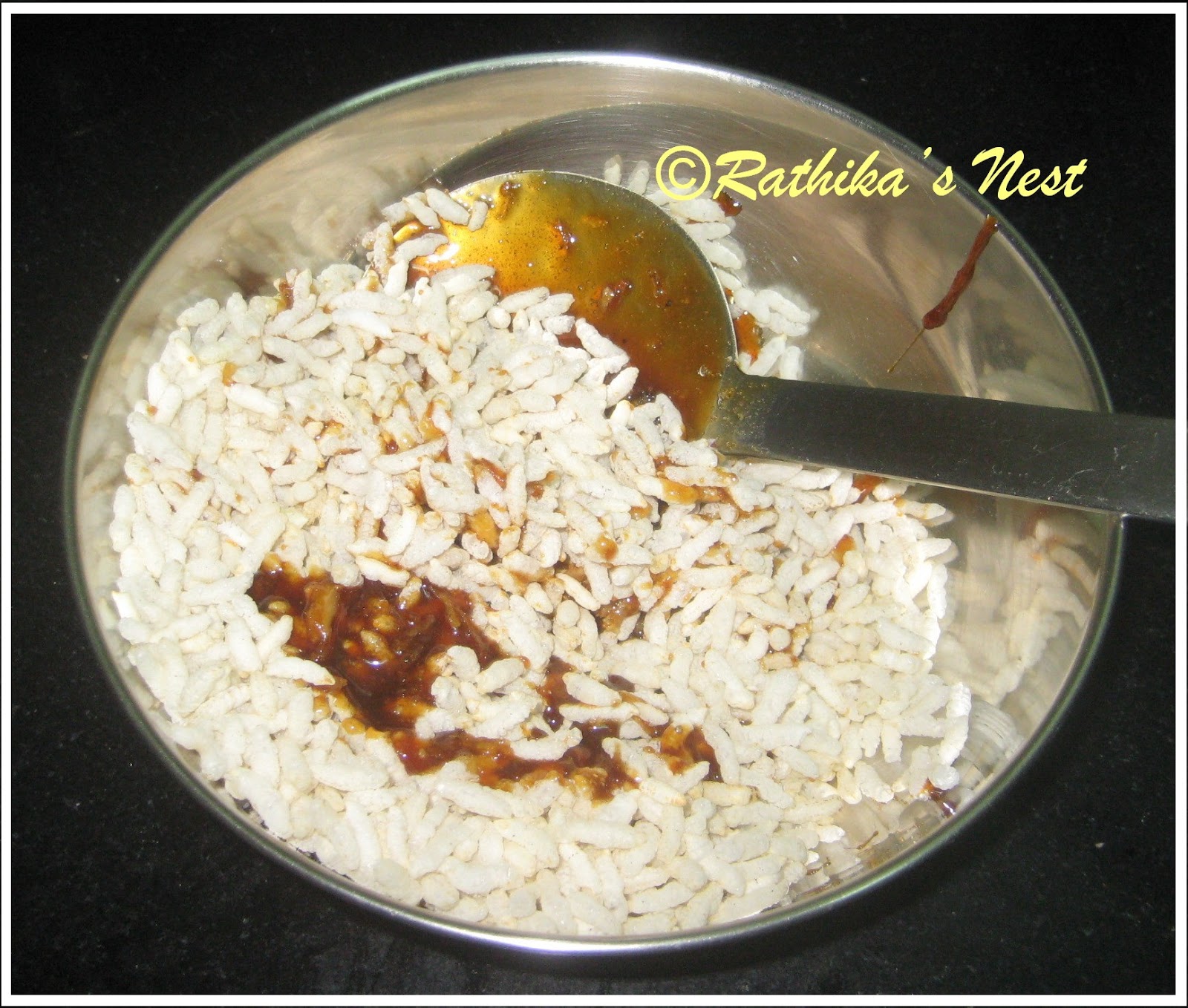
How to make the balls: Spread a portion ( 1-2 teacups) of the pori in a wide mouthed vessel. Top it with a ladleful of syrup (Fig.5). Mix together using a spoon. 


Fig.5: Pour jaggery syrup on top of pori and mix well
Dust your hands with rice flour. Take a handful of mixture and shape it into a ball. Keep adding pori and syrup to the vessel as needed, mix the contents and shape into balls. Repeat this process till you use up the entire quantity of pori and syrup. Store the balls in an air-tight container.

Pori Urundai (பொரி உருண்டை)
Note: You may find it difficult to shape the balls if the syrup turns cold. Hence, it is preferable to take the assistance of another person while shaping the 'pori urundai'. 

If you like this post, please share it with your friends, followers or contacts, by just clicking the 'Face book', 'Twitter', ‘Pinterest’ or 'Google +’ icons you see below the post. Feel free to post your comment/ feedback. Your support is greatly appreciated. Thank you!

Saturday, 7 November 2015

Mysore Pak (மைசூர் பாகு)

Mysore pak (மைசூர் பாகு) has been served in feasts during festivals and weddings for many generations. My grandmother used to make it for Diwali. I have tasted different types of Mysore pak from the firm ones made in the sweet shops or ‘lala kadai’ (லாலா கடை) to the very soft ones that are made by traditional cooks. According to legend, around the year 1935, this sweet was first made by the Mysore royal chef Kakasura Madappa to serve the then King of Mysore, Krishna Raja Wodeyar IV. The king enjoyed the new sweet 'Mysore paka', which was soon designated as the royal sweet! Mysore pak is a very tasty sweet, but has high content of sugar and ghee! Nonetheless, it doesn’t hurt to indulge once in a while, especially when 'king of the sweets' is tempting you! So, let’s make Mysore pak for this Diwali! Here we go.

Ingredients: (Makes 25-30 pieces depending on the size)

Fig.1: String consistency
Bengal gram flour or besan (கடலை மாவு) – 1 teacup or 200ml measure
Sugar – 3 teacups or 600ml measure
Ghee – 1½ teacup or 300ml measure*

*Mysore pak made with these ingredients is soft and just melts in your mouth. However, if you want the sweet to be very soft, increase the quantity of ghee to 2½ teacups or 500ml (!).

Method: Smear a tray with ghee and keep aside. Heat sugar with 1¼ teacup (250ml) of water in a fairly large kadai and bring it to boil. Then reduce the flame to medium, and keep stirring till the syrup reaches string consistency. 

How to check the consistency of sugar syrup: Place a drop of the syrup on a plate and let it cool. Touch the syrup with your index finger and press it with your thumb. Then separate the fingers. If the syrup stretches as a thick string between the fingers, it has reached the right ‘string consistency’ (கம்பிப் பாகு). See Figure 1.

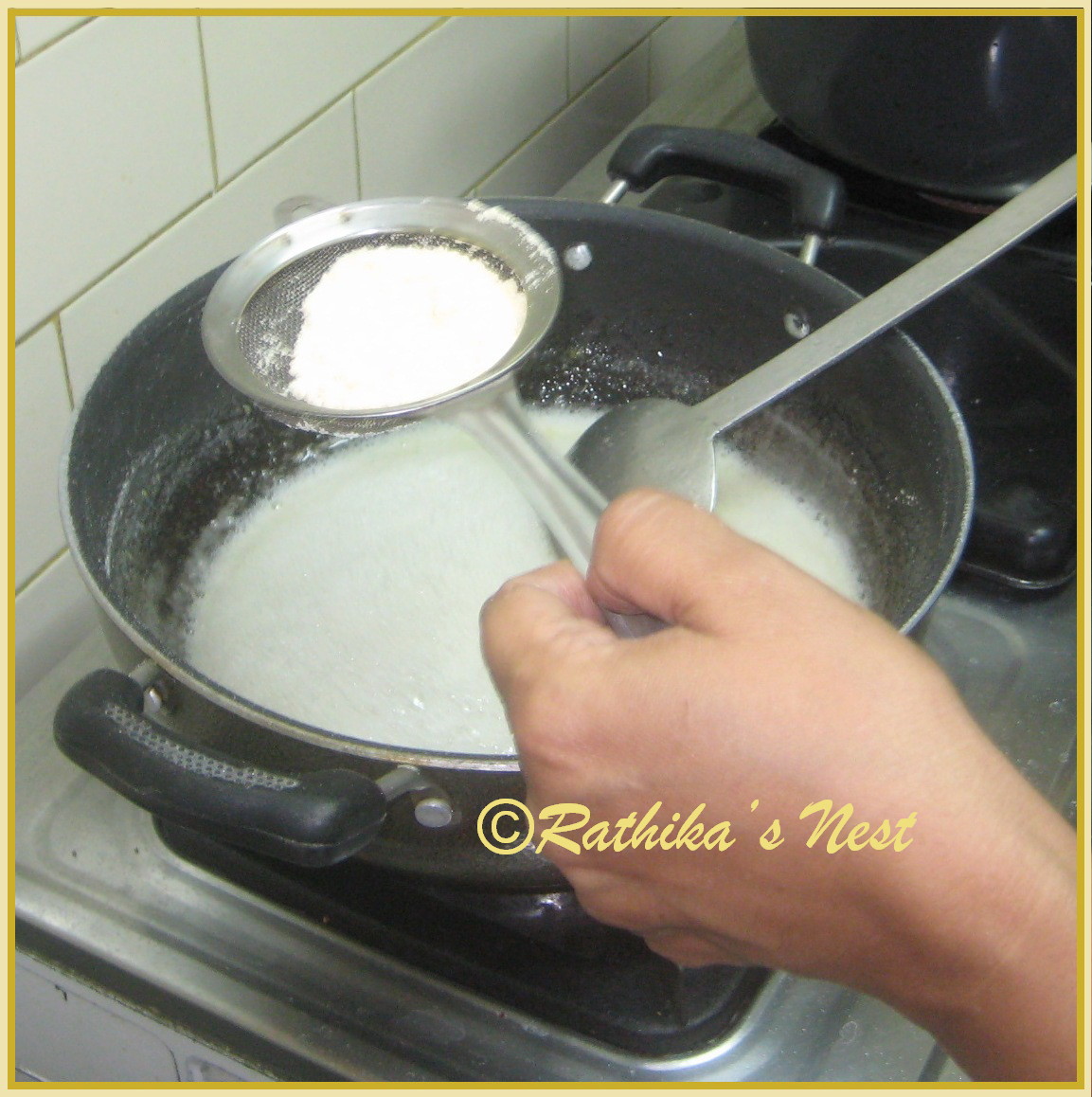
Now start adding Bengal gram flour using a tea filter little by little. Take 1 tablespoon of Bengal gram flour and sprinkle it using the tea filter while stirring continuously to avoid forming lumps (Fig.2). You may take the help of someone else if you find it difficult to manage both tasks.
Fig.2: Sprinkle Bengal gram flour using a tea filter
Once the flour is fully mixed with the sugar syrup, add 1 teaspoon of ghee and blend well with the contents (Fig.3).

Fig.3: Add ghee and flour alternatively
Likewise keep adding Bengal gram flour and ghee alternatively till the entire quantity of flour is used up (Fig.4).

Fig.4: Contents after all the flour is added
Now add in the remaining ghee little by little, as you keep stirring the contents. Continue to cook on medium flame till the contents start to froth and form a mass (Fig.5). At this stage, you would smell the nice aroma of Mysore pak.

Fig.5: Contents froth and form a mass
Switch off the stove and transfer the contents to the greased tray. Smear little ghee on the undersurface of a katori (small serving cup), and use it to gently press and flatten the surface of the sweet (Fig.6).

Fig.6: Spread the contents in a greased tray
Allow the sweet to cool for 15-20 minutes. Later, cut the sweet in to square or rectangular pieces using a knife (Fig.7).
Fig.7: Cut the sweet into pieces
When Mysore pak cools to room temperature, separate the pieces and store them in clean, dry, air-tight container. Try the 'king of sweets' this Diwali!

Mysore Pak (மைசூர் பாகு)
Note: I have used a tray that is 1" deep, and the proposed quantity of ingredients have yielded 25 pieces (approximately 1" x 1" x 1" size). However, if you use a shallow tray you may get up to 30-35 pieces of Mysore pak.


If you like this post, please share it with your friends, followers or contacts, by just clicking the 'Face book', 'Twitter', ‘Pinterest’ or 'Google +’ icons you see below the post. Feel free to post your comment/ feedback. Your support is greatly appreciated. Thank you!